
Tenth pre-congress Special Report studies promises and pitfalls
of profound technological changes impacting industry
AUGUST 27, 2026
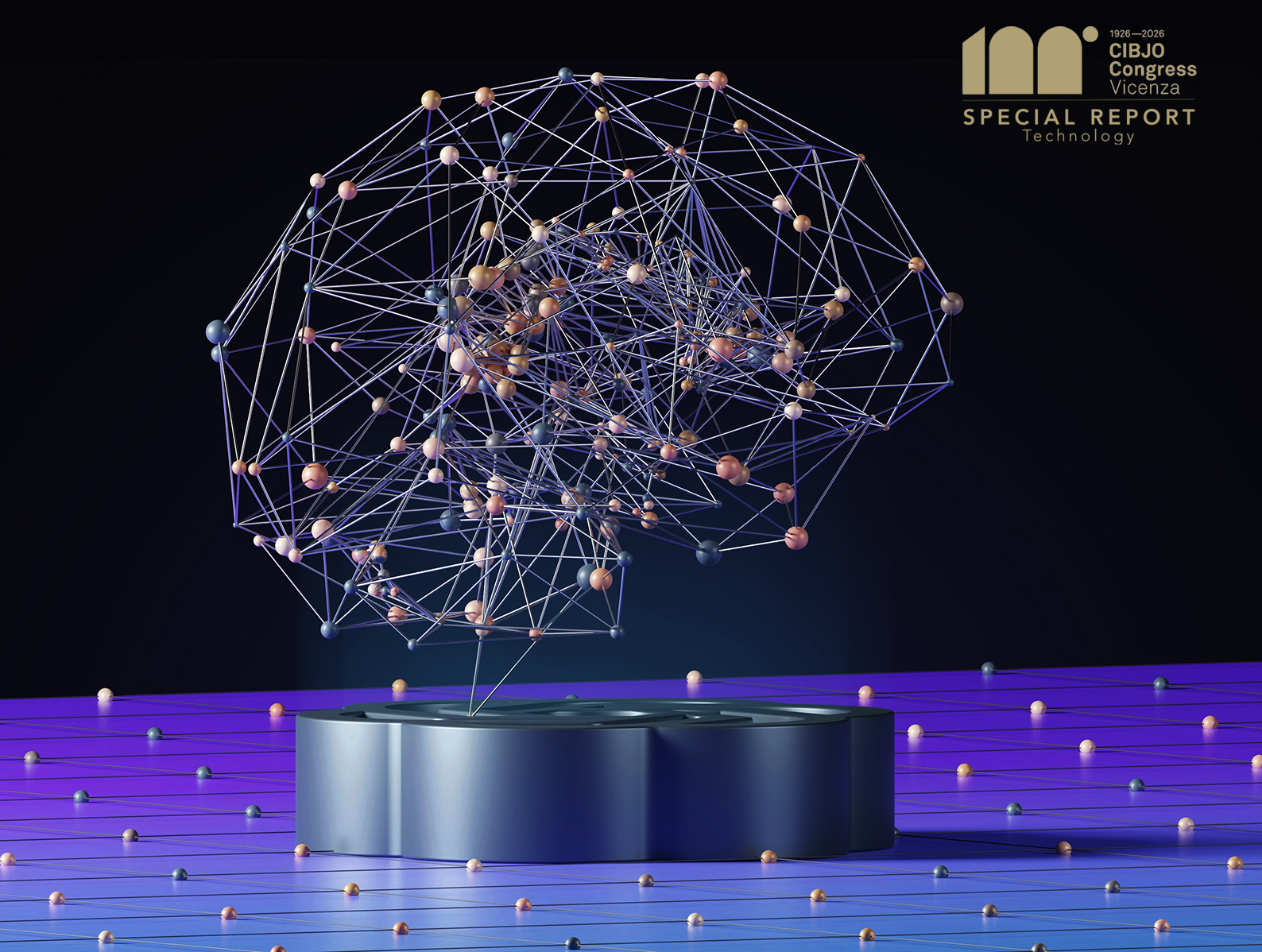
With little more than one week to go to the opening of the 2026 CIBJO Congress in Vicenza, Italy, on September 4, 2026, the tenth and final pre-congress Special Report has been released. Prepared by the CIBJO Technology Committee, headed by Stéphane Fischler, the report provides an overview of the technologies likely to fundamentally change the way jewellery is produced and sold, but it also considers what needs to be done to preserve the element of human individuality in the jewellery craft.
“AI, blockchain, the Internet of Things (IoT) and advanced data analytics are reshaping every node of the supply chain, from mine to market,” Mr. Fischler writes. “These innovations promise greater efficiency, traceability and personalisation, but they also introduce new risks around data governance, cultural identity, workforce displacement and the preservation of artisanal craft.”
Certain of the risks posed by the new technology are not immediately obvious, and among these are the dangers to privacy posed by systems which collect information from the people and companies that use them.
“Augmented-reality try-on tools also capture biometric data, such as facial geometry and hand proportions, which requires particular care,” Mr. Fischler points out. “Supply-chain data sharing compounds the risk.”
“The concentration of sensitive data creates significant risk. Jewellers hold high-net-worth customer profiles — names, addresses, purchase values and biographical milestone data — that are attractive targets for cybercriminals. A breach does not expose only individual customers; it can permanently damage the trust on which fine jewellery brands depend,” he notes.
Artificial intelligence is almost certainly the most powerful and disruptive of the new technological tools, and an over-reliance on its generative capability could inject elements of uniformity, particularly where it comes to jewellery design.
“AI design tools are structurally inclined to produce the most statistically central result: designs reflecting the average of what has already been made,” Mr. Fischler writes. “In practice, this means the over-representation of Western European jewellery traditions and the systematic under-generation of Mughal, West African, East Asian and indigenous aesthetic vocabularies.”
“The risk is a homogenisation of global jewellery design — a narrowing, rather than an expansion, of creative possibility,” he adds.
“A jewellery brand’s story, like the cultural significance of a stone, is not a fixed catalogue of facts but a living narrative, shaped in the telling and tailored to each new audience,” Mr. Fischler says. “AI can preserve the archive; it cannot perform the story.”
“The most durable competitive advantage will belong to those firms that understand this difference and invest accordingly — in the people, practices and curatorial intelligence that transform stored knowledge into expressed identity,” he writes.