Second pre-congress Special Report focuses on education,
looks at new jewellery academy and opal and jade guides
JULY 7, 2026
With fewer than nine weeks to go to the opening of the 2026 CIBJO Congress in Vicenza, Italy, on September 4, 2026, the second of the pre-congress Special Reports has been released. Prepared by the CIBJO Marketing and Education Commission, headed by Jonathan Kendall, the report details the establishment of the International Fine Jewellery Academy (IFJA), one of the most significant educational initiatives promoted by CIBJO in recent years, and previews two new gemstone guides, one dedicated to opal and other to jade.
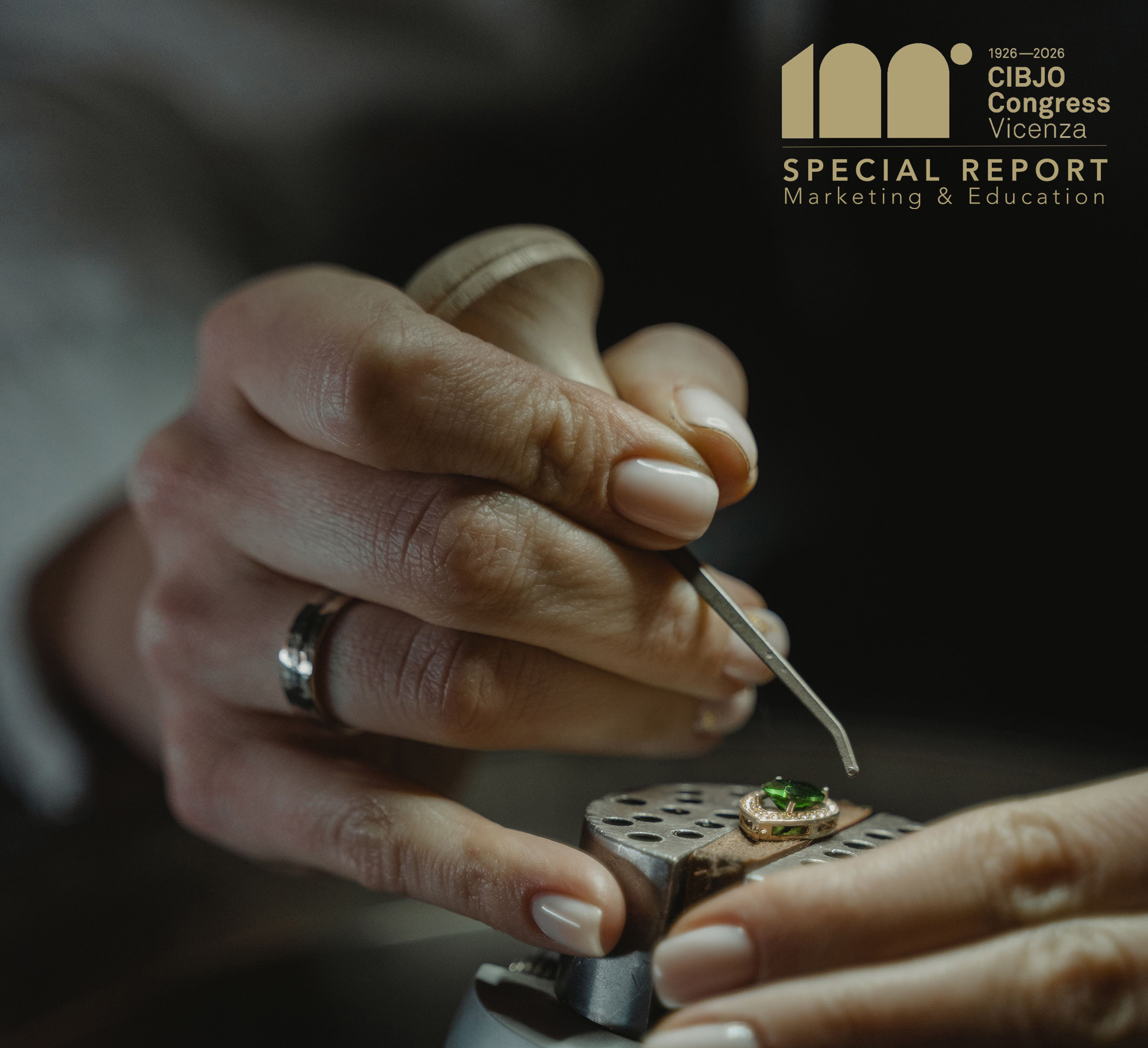
IFJA stems from the collaboration between CIBJO, Fondazione Mani Intelligenti of Valenza, Confcommercio Milano, and CAPAC – Politecnico del Commercio e del Turismo. It is a hands-on jewellery academy designed to educate future generations of professionals. Based in Milan, its programmes will include theoretical instruction delivered in English and practical training in specialised laboratories, alongside internships with master artisans at partner companies in the north of Italy.
IFJA’s educational programmes will include in-depth study of international industry standards, integrating CIBJO principles relating to sustainability, ESG, responsible sourcing, transparency, and supply chain traceability.
A fundamental element of the new academy is its connection with the productive sector. “Through partnerships with companies, workshops, designers, manufacturers, and industry organisations, IFJA will provide students with meaningful opportunities for experiential learning,” writes Mr. Kendall. “These industry collaborations will integrate theoretical education with practical experience, facilitating the direct transfer of professional expertise and supporting young professionals in their transition into the labour market.”
The new gem guides were developed by two expert working groups under the leadership of the Coloured Stone Commission.
“On the face of it, given that we are only speaking about two gem materials, this sounds like a simple task,” Mr. Kendall writes. “However, the facts (nomenclature, history, and lore) surrounding both gems have been blurred for too long by ‘opinions’ and certainly by a lack of understanding of differing ‘cultures.’”
This is especially true of jade, which is traditionally has included products far more popular in the East, and particularly China, than in Western markets. As Mr. Kendall points out, the Jade Guide provides a clear, integrated relationship chart that links traditional Chinese terms with those used in the West. Appendices set out the Chinese trade names for fei cui, and the English terms and pronunciation are tabulated alongside simplified Chinese, pinyin, and the international phonetic alphabet.