CIBJO Congress 2026 – GemmologySteven Benson2026-08-05T11:39:17+02:00
SPECIAL REPORT
GEMMOLOGY
Photo credit: Jimmy Chan on Pexels.com.
The vital role of protecting gemmological laboratory best practices
By Hanco Zwaan President Gemmological Commission
Over the years, CIBJO’s Gemmological Commission has played a vital role in developing standards for gemmological laboratories to implement, in terms of best practices in management, technical requirements, and testing protocols with recommended testing methods for the identification of each gem material.
CIBJO recognises that gemmological laboratories are a critical factor in the conveyance of scientifically correct information to the industry and to consumers. However, we continue to receive concerns from the industry at large, as well as suppliers and consumers, about inconsistent reporting, mainly with respect to treatments and geographic origin.
Although high-standard technologies are available and in use, it is often perceived that the human factor remains highly influential, particularly when the results of analyses are presented. In many cases, this cannot be avoided, as reaching a finding from collected data is not always straightforward, and certain decisions require interpretation.
But there are also reported instances of dishonest practice. These include the misuse of technical nomenclature on reports, as well as the issuing of reports for treated stones, where the gemmological report was produced before the stones were treated. These are clearly acts of fraud.
Photo credit: Vladimir Srajber on Pexels.com.
Harmonising the use of variety and trade names
We recommend that laboratories increase their competence at all levels and that consumer protection be considered their first priority. The Gemmological Commission will continue tirelessly to defend both the consumer and the industry.
The trade and gemmological laboratories should work together to provide correct information on gemstones at all levels. We recommend that laboratories carefully implement best practices, as laid out in the CIBJO Gemmological Laboratory Blue Book.
A new chapter in the book lists the status of gemstone names used and provides definitions of gem varieties. It was added with the goal of harmonising the use of variety and trade names, especially in borderline cases. In this area, there is still a great deal of work to be done.
In the long run, improvement of definitions will not only protect the consumer, but also increase consumer confidence.
We are thus pleased to report that the Gem and Jewelry Institute of Thailand (GIT) recently announced that it is going to integrate the list of minerals, gem varieties and trade names, and their criteria that appear in the CIBJO Gemmological Laboratories Blue Book into the revised Thailand National Standard of Gemstone Vocabulary.
Photo credit: Efe Burak Baydar on Pexels.com.
Listing of labs unfeasible, but mission continues
As we reported we would do last year, in 2026 we considered the possibility of producing a listing of laboratories that are willing to comply with the recommended best practices in the CIBJO Gemmological Laboratory Blue Book. It was felt that this could provide a way for the trade and the public to identify laboratories committed to resolving the challenge of inconsistent results, and to improving consistency in test results and reporting.
However, after lengthy deliberation, it was concluded that this type of listing was not feasible for CIBJO, from both a legal and a practical perspective.
Be that as it may, the CIBJO Gemmological Commission will remain the platform for laboratories to discuss all pressing issues, to harmonise practices and nomenclature, to promote speaking the same language, and for the trade and laboratories to work together in openly circulating key gemmological information. This mission is especially relevant when new products are introduced into the market.
In addition, the members of the commission will continue to support other commissions and working groups, for example in the creation of guides, such as the new Jade (Fei Cui) Guide and Opal Guide, which are being presented at the upcoming congress.
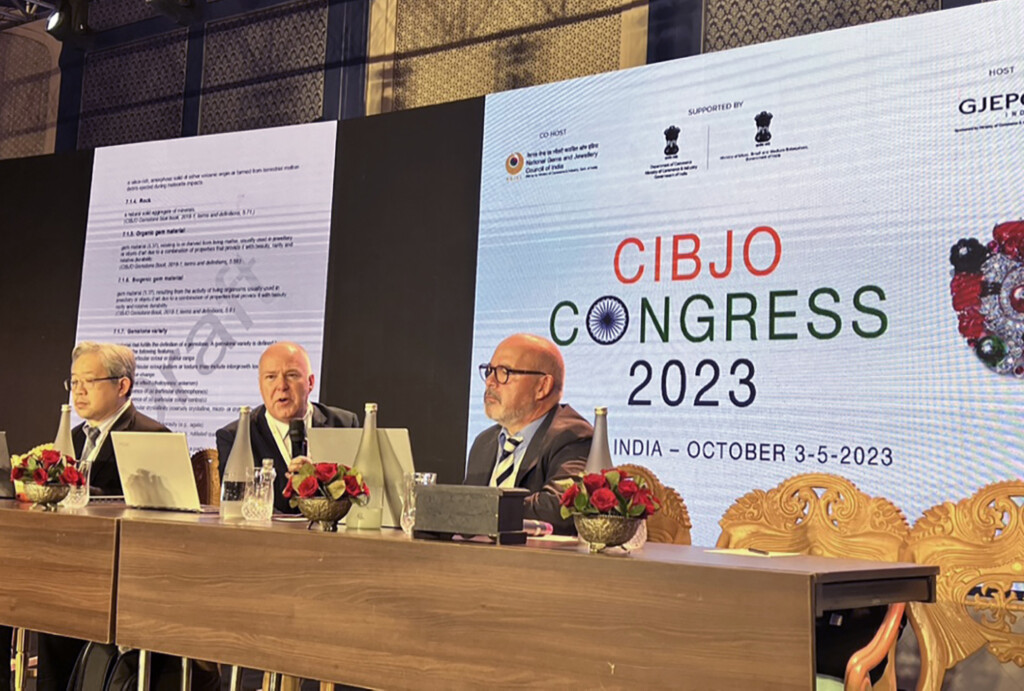
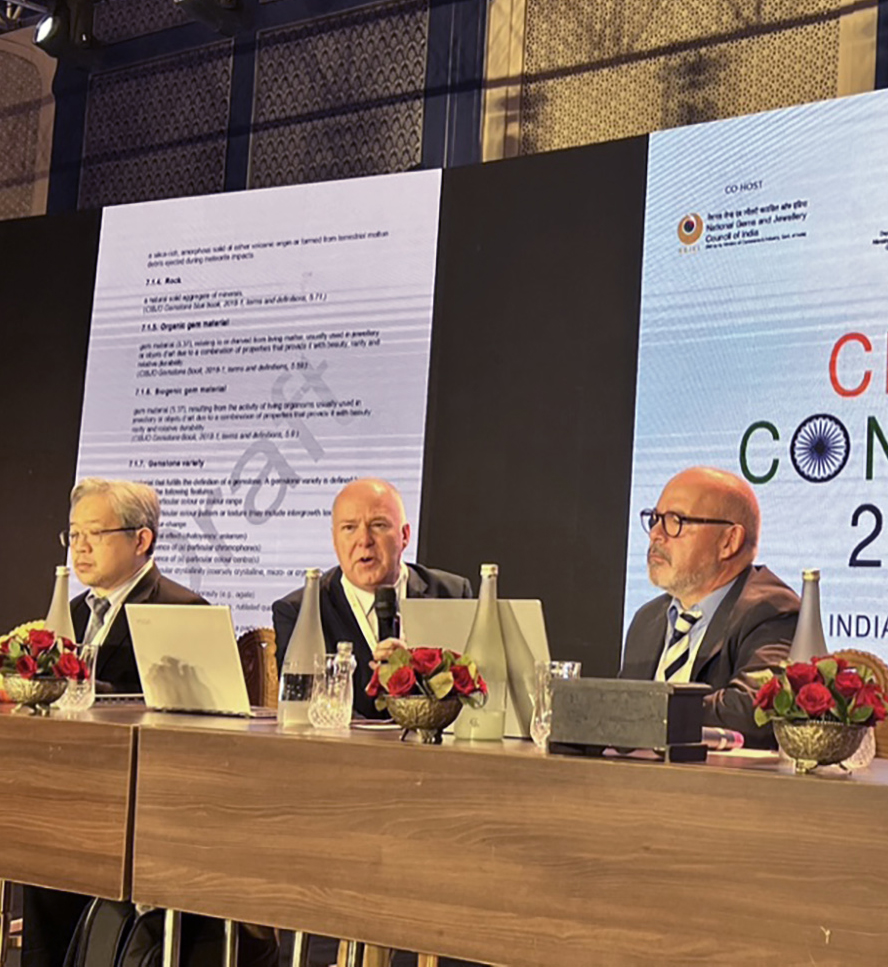
The Gemmological Commission in session at the CIBJO Congress in Jaipur, India, in October 2023. The commission president Hanco Zwaan (centre) is flanked by the two commission vice presidents, Thanong Leelawatanasuk (left) and Claudio Milisenda.
A changing of the guard
On a personal note, after many years I will be stepping down as President of the Gemmological Commission, following the Centenary CIBJO Congress in Vicenza.
Subject to the approval of the CIBJO Board of Directors, I will be succeeded by Claudio Milisenda, who is currently one of the commission’s two vice presidents.
I am grateful for the continued support I have received over the years, first of all from the President of CIBJO, Gaetano Cavalieri, the CIBJO Board, and my vice presidents Claudio and Thanong Leelawatanasuk, as well as from the members of the Gemmological Commission Steering Committee and the presidents of the other commissions in Sector A, which covers all gem materials.
I would also like to pay tribute to the Naturalis Biodiversity Center and the Netherlands Gem Laboratory, based in Leiden in the Netherlands, not only for their generous support of my travel during my time in office, but also for generously allowing the time I spent on CIBJO matters.